Showing posts with label software cost calculator. Show all posts

Monday, September 30, 2024

Cost Estimating Software vs. Traditional Methods: A Comparative Analysis


Introduction

Precise cost estimation can significantly influence project outcomes in project management and budgeting. With the growing complexity of projects, the need for accurate estimates has become more critical than ever. 

The rise of technological advancements has introduced tools like software cost calculators one of which is creole studios free estimating software, which offer a digital approach to estimation, intensifying the debate between using these tools and sticking to traditional methods. This blog explores the strengths and weaknesses of each approach, helping project leaders make informed decisions.

Understanding Traditional Cost Estimation Methods

Software cost estimation is vital in project management, determining the feasibility, scope, and budget. Common traditional methods, such as analogous, parametric, and bottom-up estimation, have been standard practices for decades. These methods rely on expert judgment and more time to calculate costs accurately.

Overview of Traditional Techniques

  • Analogous Estimation: Relies on historical data from similar projects to provide an estimate. It’s often used in the early stages of project planning when limited information is available.
  • Parametric Estimation: Uses statistical models and historical data to predict future costs based on project parameters such as size and duration.
  • Bottom-Up Estimation: Breaks down the project into smaller tasks and activities, estimating costs for each part, and then aggregating these to get the total project cost.

Advantages of Traditional Methods

  • Historical Insight: Techniques like analogous estimation leverage historical data from past projects, providing valuable insights and context that digital tools might overlook. This historical perspective can help identify potential risks and opportunities that are specific to the industry or project type.
  • Expert Judgment: Traditional estimation methods rely heavily on the expertise and intuition of experienced estimators. Their ability to interpret data, consider qualitative factors, and apply judgment in uncertain situations can lead to more accurate and reliable cost estimates.

Limitations of Traditional Methods

  • Time Consumption and Effort: These methods are often rely on expert intervention, and requiring significant time to gather data and make calculations, which can delay project planning.
  • Subjectivity and Inconsistency: Different estimators may arrive at varying conclusions given the same data, leading to inconsistencies that can affect project budgeting and planning.

Read more: Common Challenges Faced in Software Cost Estimation and How to Overcome Them

The Rise of Cost Estimating Software

In recent years, specialized cost estimating software tools has revolutionized project management and budgeting. These digital solutions provide enhanced accuracy and efficiency, significantly reducing the likelihood of human error.

Key Features of Cost Estimating Software

  • Current Estimates: Unlike static spreadsheets, these tools provides real-time UI/UX and developer rates, ensuring that estimates are always current.
  • Scalability and Adaptability: As projects grow in complexity, cost estimating software will share the rates after including the additional features accurately in no time.

Advantages of Cost Estimating Software

  • Time Efficiency and Accuracy: Automated tools can perform tasks faster than manual methods. For instance, a software development team might use a tool to quickly estimate the cost of new features by referencing the resources used in previous updates.
  • User-Friendly and Accessible: Software cost calculators are designed to be straightforward, allowing users to input various project parameters such as the type of software, number of pages, complexity, and required integrations. This makes them accessible to both technical and non-technical users, enabling quick and easy cost estimation without the need for deep technical knowledge.

Tools like the free estimating software which is a software cost calculator help in predicting costs based on various project parameters, making budget planning more efficient.

Read more: Factors to Consider When Choosing a Software Development Cost Calculator

Making the Right Choice for Your Project

Choosing between traditional cost estimation methods and modern cost estimating software depends on various factors. Understanding these factors can help in making an informed decision.

Factors to Consider

  • Project Scope and Size: Larger and more complex projects may benefit more from automated tools that give proper cost estimate, whereas smaller projects might still work with manual method.
  • Manage Budget: Traditional method does not provide the accurate estimates, however on the other side cost estimating software provides with details breakdown of the cost where the funds will be utilized, this allows companies to manage budget and decide what features are most important to them.

Future Trends and Innovations

  • Integration with AI and Machine Learning: Emerging technologies can further refine cost predictions by learning from past projects and making real-time adjustments as new data becomes available.
  • Enhancements in Predictive Modeling: Future advancements promise to make these tools even more reliable and efficient, potentially altering the landscape of cost estimation.

Read more: Top 7 Factors That Influence Software Development Cost

Conclusion

Both traditional and digital methods have their place in cost estimation. The choice between manual processes and utilizing a free estimating software depends on project specifics, available resources, and required accuracy. For projects that demand high precision and involve complex variables, cost estimating software might offer a distinct advantage. Understanding the strengths and limitations of each approach can guide project leaders toward the method that best aligns with their goals, ensuring accurate and reliable cost estimates.

Source: Creole Studios

Wednesday, July 24, 2024

HOW TO CALCULATE COST FOR AN OFFSHORE SOFTWARE DEVELOPMENT TEAM

Summary:

To calculate the cost of an offshore software development team, define your project scope, identify required team members, determine their hourly rates based on location, estimate project duration, factor in infrastructure and communication expenses, and use free cost estimating software for accuracy and transparency.

What is Offshore Software Development Team:

Offshore software development teams are composed of programmers, designers, and project managers who work in a different location from the client. These teams are often engaged by companies that require customized software programs or websites but lack the internal expertise or resources to do so.

By hiring offshore software development teams, businesses can benefit from faster project completion, access to a wider pool of talent, and cost efficiencies. Moreover, offshore teams can provide specialized expertise in specific programming languages or software development processes.

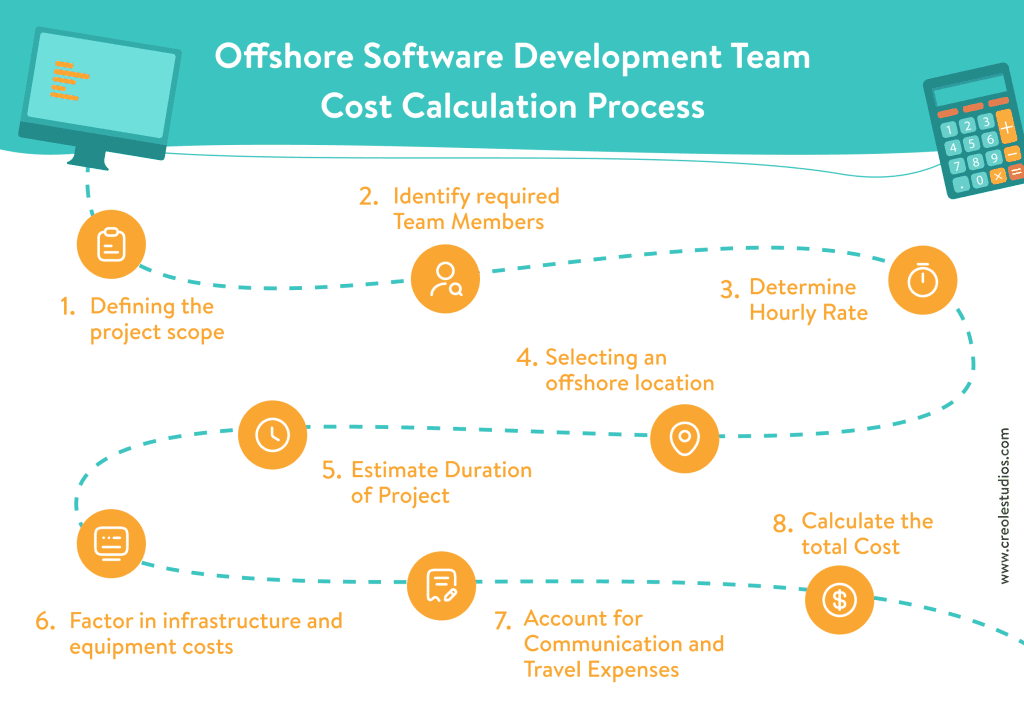
Offshore Software Development Team Cost Calculation Process:

To determine the cost of an offshore software development team, several key factors must be considered. The process involves several steps, which include:

Defining the Project Scope

This involves specifying the project’s requirements, such as desired features, functionalities, and outputs that the offshore software development team is expected to deliver. Clearly defining the scope helps in understanding the exact needs of the project. Free cost estimating software can assist in documenting and refining these requirements, providing a detailed view of the project’s scope. This software helps ensure all stakeholders have a clear understanding of what the project entails and sets the stage for accurate cost estimation.

Identifying Required Team Members

Determine the types of team members needed for the project, including developers, designers, project managers, and QA engineers. Based on the project’s scope, identify the number of team members required for each role. Quotation software can be beneficial in outlining these needs by creating a detailed breakdown of the skills and expertise needed. This helps in forming a well-rounded team capable of delivering the project effectively.

Determining the Hourly Rate

One crucial factor in estimating the cost of offshore software development is the hourly rate of the offshore team. This rate can vary based on the team’s location, expertise, and experience. Cost estimating software can help research and compare hourly rates for comparable tasks in the region where the offshore team is situated. This ensures that the budget aligns with the market rates and helps avoid over or underestimating the costs.

Selecting an Offshore Location

Choosing an offshore location involves considering factors such as cost of living, infrastructure, and the available talent pool. The location significantly impacts the hourly charges for the services provided. Free estimating software can be useful in comparing costs across different locations, helping you select a region that offers the best balance between cost and quality of service.

Estimating the Duration of the Project

Determining the project’s duration is another important step in estimating the cost. The duration can be influenced by the project’s complexity, scope, and the size of the team involved. Free cost estimating software can assist in estimating the time needed by drawing on prior experience or industry standards. This helps in setting realistic timelines and budgeting appropriately for the project’s duration.

Factoring in Infrastructure and Equipment Costs

It’s important to consider costs related to infrastructure and equipment when estimating the cost of offshore software development. These costs include expenses for hardware, software licenses, office space, and internet connectivity. Cost estimating software can help account for these expenses, ensuring that all necessary resources are budgeted for accurately.

Accounting for Communication and Travel Expenses

Regular communication with the client team and potential travel expenses are crucial factors to incorporate into the budget. Offshore software development teams may incur additional costs for phone and internet charges. Moreover, there might be travel expenses associated with team members visiting the client’s location for crucial meetings or project milestones. Free estimating software can help in budgeting for these additional costs, ensuring they are not overlooked.

Calculating the Total Cost

To determine the total cost of the offshore software development team, all the expenses mentioned previously need to be added up. Leveraging free estimating software can simplify this process by providing a detailed breakdown of costs based on your inputs. This comprehensive calculation helps in forming an accurate budget, facilitating better financial planning and management for the project.

Read more: Understanding the importance of software cost estimation in project management. 

How Cost Estimating Software Enables you to Calculate Cost of your Offshore Software Development Team:

The Cost Estimating Software can help you estimate offshore development team costs based on the size of the team you choose based on your project scope. This estimated cost will include the expenses related to hiring project managers, designers, developers, QA engineers, and any other team members required for the project. Once you have reviewed the initial estimate, you can adjust the project details such as the team size to modify the cost of assembling an offshore software development team. Using the software cost calculator, you can determine your project budget and gain a clearer understanding of the costs involved in offshore software development.  Many businesses leverage this free estimating software to enhance accuracy and transparency in their cost calculations.

Read more: Factors to consider when choosing a software development cost calculator

Benefits of Software cost Calculator to determine Offshore Software Development Team Cost:

software cost estimation can be a valuable tool in determining the cost of an offshore software development team. Here are some of the benefits of using a software cost calculator:

  1. Accuracy: Providing an accurate estimation of the cost of an offshore development team can be achieved by utilizing a software cost calculator that considers variables such as team size, project complexity, and location.
  2. Transparency: Using cost estimation software can increase transparency in the costing process, ensuring that all stakeholders are informed of the project’s financial consequences. 
  3. Efficiency: By providing quick estimates, cost estimation software can assist in saving time and effort while evaluating the feasibility and financial viability of a project.
  4. Cost Control:  Utilizing quotation software to generate an accurate cost estimate before initiating work can assist organizations in effectively managing expenses, as well as facilitating improved planning and forecasting capabilities.
  5. Competitive Advantage: By leveraging software cost estimation tools to accurately estimate project expenses, businesses can enhance their competitive advantage and offer clients more cost-effective pricing.
  6. Flexibility: Utilizing software cost estimation tools to evaluate the expenses of different project scenarios enables businesses to compare costs associated with various team sizes, project durations, and other variables.

Incorporating tools like cost estimating software can streamline the cost calculation process.

Overall, a software cost calculator can be a valuable resource for companies seeking to accurately determine the cost of offshore software development teams and to make informed decisions regarding their outsourcing strategy.

How Do I Hire an Offshore Software Development Team?

Hiring an offshore software development team involves several key steps to ensure you select the right team for your project and manage costs effectively. 

Define Your Project Requirements: Before beginning the hiring process, clearly define your project’s scope, including the features, functionalities, and expected deliverables.

Research and Shortlist Candidates: Conduct thorough research to identify potential offshore software development teams.

Evaluate Team Expertise and Fit: Assess the expertise and cultural fit of the offshore teams you are considering. Review their portfolios and case studies to ensure they have experience with similar projects. 

Request Proposals and Quotes: Request detailed proposals and quotes from the shortlisted teams. Ensure that the proposals include a breakdown of costs, timelines, and deliverables. Free estimating software can streamline this process by providing you with a template to compare different proposals easily.

Review and Evaluate: Upon project completion, review the results and evaluate the performance of the offshore team. This feedback will be valuable for future projects and can help you refine your cost estimation and hiring process.

Conclusion:

Accurately calculating the cost of an offshore software development team is essential for effective project management and budgeting. By defining your project scope, identifying required team members, determining hourly rates, estimating project duration, and considering infrastructure and communication expenses, you can achieve precise cost estimation. Leveraging cost estimating software simplifies this process, providing tools for documentation, comparison, and detailed breakdowns of expenses. This ensures transparency and helps businesses make informed decisions, manage expenses effectively, and maintain a competitive edge. Incorporating these steps will lead to a successful and cost-efficient offshore software development project.

Source: Creole Studios

Tuesday, April 30, 2024

The Role of Artificial Intelligence in Enhancing Software Cost Estimation Accuracy


Summary

Software cost estimation is a critical aspect of project planning, helping stakeholders allocate resources effectively. Traditional methods often struggle with accuracy due to their reliance on historical data and assumptions. However, the integration of artificial intelligence (AI) techniques have revolutionized this process, enhancing accuracy and efficiency. This article explores the role of AI in software cost estimation, highlighting its benefits, techniques, and future trends.

Introduction

Accurate cost estimation is crucial for the success of software development projects. Artificial Intelligence (AI) is now stepping in to address this challenge. Software Cost Estimation Tool leverages advanced algorithms and data analysis to provide more precise and reliable estimates. Overestimation inflates budgets, while underestimation causes delays. Traditional methods may lack precision and overlook project complexities. In contrast, AI offers a data-driven approach that leverages algorithms to analyze various factors and predict costs more accurately.

Read More: Common Challenges Faced in Software Cost Estimation and How to Overcome Them

How is Artificial Intelligence Cost-Effective?

AI streamlines the cost estimation process by automating tasks, reducing manual effort, and improving accuracy. It analyzes vast amounts of data, including project requirements, historical performance, and industry benchmarks, to generate reliable estimates. Additionally, AI algorithms continuously learn and adapt, refining their predictions over time and increasing cost estimation accuracy. Studies indicate a high failure rate, ranging from 50% to 80%. This is where AI plays an important role in every software project estimate.

Introduction to AI in Software Cost Estimation

Artificial Intelligence (AI) has revolutionized various industries, and software development is no exception. Regarding software cost estimation, AI influences software development costs and offers powerful tools and techniques that can significantly enhance accuracy, efficiency, and reliability. Here’s an introduction to AI in software cost estimation:

1. Data Analysis and Pattern Recognition: AI algorithms can analyze vast amounts of historical data related to software development projects. By recognizing patterns in this data, AI systems can identify correlations between various project parameters and final costs. This helps in creating more accurate estimates based on similarities to past projects.

2. Predictive Modeling: AI techniques such as machine learning enable the development of predictive models for software cost estimation. These models can learn from past projects and make predictions about the cost, effort, and timeline of future projects. As more data is fed into these models, they become increasingly accurate.

3. Feature-Based Estimation: AI-powered software can automatically analyze project requirements and features to estimate their impact on cost. By examining factors such as complexity, size, and interdependencies of features, AI algorithms can provide detailed and granular cost estimates.

4. Risk Assessment: AI can help in identifying and assessing risks associated with software development projects. By analyzing historical data and project parameters, AI systems can flag potential risks that may lead to cost overruns or delays. This enables project managers to proactively mitigate risks and adjust cost estimates accordingly.

5. Natural Language Processing (NLP): NLP techniques allow AI systems to interpret and analyze unstructured data such as project documentation, emails, and communication logs. By extracting relevant information from these sources, AI can refine cost estimates and capture nuances that may impact project costs.

6. Continuous Learning: AI-powered cost estimation systems can continuously learn and improve over time. As new data becomes available and more projects are completed, these systems can adapt their models and algorithms to reflect evolving trends and factors influencing software development costs.

7. Automation: AI can automate various aspects of the cost estimation process, reducing the need for manual intervention and speeding up the estimation process. This includes tasks such as data collection, analysis, and generating cost estimates based on predefined models and parameters.

8. Integration with Project Management Tools: AI-powered cost estimation tools can integrate seamlessly with project management software, enabling real-time cost tracking, monitoring, and adjustment throughout the project lifecycle. This integration ensures that cost estimates remain accurate and up-to-date as the project progresses.

Read More: Understanding the Importance of Software Cost Estimation in Project Management

AI Techniques for Software Cost Estimation

Here are some commonly used AI techniques for software cost estimation:

1. Machine Learning (ML):

  • Regression Models: ML regression algorithms, such as linear regression, polynomial regression, or more advanced techniques like support vector regression (SVR) or random forest regression, can be trained on historical project data to predict software development costs based on various features like project size, complexity, team experience, etc.
  • Neural Networks: Deep learning techniques, such as artificial neural networks (ANN) or convolutional neural networks (CNN), can learn complex patterns from large datasets to predict software development costs. They may require substantial amounts of data but can capture intricate relationships between input features and cost outputs.

2. Bayesian Networks:

  • Bayesian networks can model probabilistic relationships between different factors affecting software development costs. They are particularly useful for handling uncertainty and incorporating expert knowledge into the estimation process.

3. Genetic Programming (GP):

  • Genetic programming is an evolutionary computation technique that can evolve mathematical models to fit historical data and predict future costs. It generates a population of potential solutions (models) and evolves them through successive generations using genetic operators such as mutation and crossover.

4. Fuzzy Logic:

  • Fuzzy logic can handle imprecise or vague inputs by assigning degrees of truth to propositions. It’s suitable for modeling complex and uncertain relationships in software cost estimation where precise numerical data may be lacking.

5. Case-Based Reasoning (CBR):

  • CBR systems store past project cases along with their corresponding costs and other relevant information. When a new estimation is required, the system retrieves similar past cases and adapts their cost estimates based on the similarities and differences between the new and past cases.

6. Monte Carlo Simulation:

  • Monte Carlo simulation involves generating thousands of possible scenarios based on probability distributions of input variables. It’s useful for assessing the range of possible outcomes and associated risks in software cost estimation.

Best Practices for Implementing AI in Software Cost Estimation

Implementing AI in software cost estimation can significantly improve accuracy and efficiency. Here are some best practices to consider:

  • Data Quality Assurance: Prioritize high-quality data collection and cleansing processes to ensure accuracy and reliability in the training datasets. Garbage in, garbage out—clean and relevant data is paramount for accurate predictions in cost estimation.
  • Algorithm Selection and Calibration: Choose appropriate machine learning algorithms tailored to the specific requirements of software cost estimation. Calibration of these algorithms is essential to fine-tune performance and mitigate biases, ensuring that predictions align closely with actual costs.
  • Feature Engineering: Invest in robust feature engineering techniques to identify and extract relevant features from raw data. These features should encapsulate various aspects of the software development process, such as project size, complexity, team experience, and technology stack, among others.
  • Continuous Model Evaluation and Improvement: Implement a framework for continuous model evaluation and improvement, incorporating feedback loops to refine algorithms over time. This iterative approach helps adapt to evolving project dynamics and enhances the accuracy of cost estimates.
  • Transparency and Interpretability: Foster transparency and interpretability in AI-driven cost estimation models to facilitate trust and understanding among stakeholders. Clear documentation of model assumptions, limitations, and decision-making processes empowers informed decision-making and promotes collaboration between technical and non-technical teams.

Read More: How to calculate cost for an offshore software development team

Future Trends and Directions

The future of AI for software cost estimation holds several promising trends and directions, especially when integrated with other emerging technologies like blockchain and IoT. Here’s a glimpse into how these integrations could shape the landscape:

1. Blockchain Integration:

  • Data Integrity and Transparency: Blockchain can ensure the integrity and transparency of data used in software cost estimation. Every piece of data can be securely recorded and time-stamped, reducing the chances of manipulation or fraud.
  • Smart Contracts: Smart contracts can automate certain aspects of the software cost estimation process, such as contract negotiation, payment terms, and project milestones. This can streamline the process and reduce administrative overhead.
  • Decentralized Collaboration: Blockchain-based platforms can facilitate decentralized collaboration among stakeholders, allowing them to securely share data and insights while maintaining data privacy and security.

2. IoT Integration:

  • Real-time Data Collection: IoT devices can provide real-time data on various aspects of software development projects, such as resource utilization, progress tracking, and quality metrics. This data can be fed into AI models for more accurate cost estimation.
  • Predictive Analytics: By analyzing IoT data streams, AI algorithms can predict potential cost overruns or schedule delays in software development projects, allowing project managers to take proactive measures.
  • Optimized Resource Allocation: IoT sensors can track the usage of physical resources (e.g., servers, equipment) and human resources (e.g., developer productivity), enabling AI algorithms to optimize resource allocation and minimize costs.

Conclusion

Artificial intelligence-driven Software Cost Estimation Tool have revolutionized project management, delivering unparalleled precision and efficiency. By harnessing AI techniques, organizations enhance decision-making, mitigate project risks, and streamline resource allocation. As AI evolves, its integration with other emerging technologies holds the promise of further enhancing the accuracy and effectiveness of software cost estimation.

Source: Creole Studios

Wednesday, March 27, 2024

Understanding the Importance of Software Cost Estimation in Project Management


Introduction:

Software development projects are complex endeavors that require meticulous planning, resource allocation, and budgeting to ensure success. At the heart of effective project management lies software cost estimation, a critical process that provides invaluable insights into the financial aspects of a project. In this article, we delve into the significance of software cost estimation in project management, exploring its definition, importance, and pivotal role throughout the project lifecycle.

Definition of Software Cost Estimation:

Software cost estimation is the process of predicting the financial resources required to complete a software development project successfully. It involves analyzing various factors such as project scope, resource requirements, timelines, and potential risks to derive accurate estimates of the project’s total cost. The goal of software cost estimation is to provide project stakeholders with essential insights into budgetary constraints, enabling informed decision-making and effective resource allocation. Utilizing a reliable software cost estimation tool enhances accuracy and efficiency in the estimation process, facilitating better project planning and management.

Read More: Factors to Consider When Choosing a Software Cost Estimation Tool

Purpose of Cost Estimation:

The primary purpose of cost estimation is to provide stakeholders with accurate and reliable estimates of project costs, enabling them to make informed decisions regarding project feasibility, budget allocation, and resource management. Cost estimation serves as a critical tool for project planning, budgeting, and control, helping organizations mitigate financial risks, optimize resource utilization, and ensure project success.

Use of Initial and Thorough Estimates:

In software project management, both initial and thorough estimates are essential for effective cost estimation. Initial estimates provide stakeholders with a high-level overview of project costs during the early stages of planning, enabling them to assess project feasibility and make preliminary budgetary decisions. Thorough estimates, on the other hand, involve detailed analysis and forecasting of project costs based on comprehensive project requirements and resource allocations. Together, these estimates help project managers develop realistic budget plans and ensure project success.

Read More: Common Challenges Faced in Software Cost Estimation and How to Overcome Them

Why is Software Estimation Important During Software Project Management?

The importance of software estimation in project management cannot be overstated. It serves as a cornerstone for effective project planning, budgeting, and execution. By providing stakeholders with realistic estimates of project costs, software estimation facilitates better decision-making, minimizes financial risks, and ensures project feasibility. Without accurate cost estimates, projects may encounter budget overruns, resource shortages, and delays, jeopardizing their success and profitability.

Importance of Cost Estimation in Project Management:

Cost estimation holds paramount importance in project management across various industries and domains. It serves as a cornerstone in the successful execution of projects by providing invaluable insights into resource requirements, budget allocation, and financial planning. Understanding the significance of cost estimation in project management entails recognizing its essential functions and contributions at every stage of the project lifecycle.

A. Essential Functions of Project Managers:

Project managers play a pivotal role in overseeing and coordinating project activities to ensure timely completion and adherence to quality standards. Central to their responsibilities is the effective management of project costs, which entails:

  • Planning and budgeting: Project managers are tasked with developing comprehensive project plans and budgets that outline the scope, objectives, timelines, and resource requirements. Cost estimation forms the basis of budgeting decisions, enabling project managers to allocate funds strategically and mitigate financial risks.
  • Resource allocation: Cost estimation guides resource allocation decisions by providing insights into labor costs, material expenses, equipment requirements, and other project-related expenditures. Project managers leverage cost estimates to optimize resource utilization and prevent resource shortages or overages.
  • Risk management: Accurate cost estimation facilitates proactive risk management by identifying potential cost overruns, budget variances, and financial uncertainties. Project managers employ risk mitigation strategies to address cost-related risks and ensure project feasibility within budgetary constraints.

Read More: How to calculate cost for an offshore software development team

B. Role of Cost Estimation in Each Phase of Project Lifecycle:

Cost estimation permeates each phase of the project lifecycle, exerting a significant influence on project planning, execution, and control. Its importance is particularly pronounced in the following phases:

  • Planning Phase: During the planning phase, cost estimation guides the formulation of project guidelines, scope definition, and financial planning. Project managers rely on cost estimates to set realistic project objectives, establish budgetary constraints, and allocate resources efficiently.
  • Execution Phase: In the execution phase, cost estimation informs resource procurement, expenditure tracking, and progress monitoring. Project managers utilize cost estimates to monitor project expenditures, track budget variances, and ensure adherence to financial targets.
  • Control Phase: During the control phase, cost estimation facilitates budget reconciliation, performance evaluation, and corrective action implementation. Project managers compare actual project costs against estimated values, analyze variances, and adjust project plans as needed to mitigate financial risks and optimize project outcomes.

C. Importance of Accurate Cost Estimation for Project Success:

The importance of accurate cost estimation cannot be overstated in project management, as it directly impacts project viability, stakeholder satisfaction, and organizational success. Accurate cost estimation enables:

  • Informed decision-making: Project managers make informed decisions based on reliable cost estimates, allowing them to allocate resources effectively, prioritize tasks, and optimize project schedules.
  • Budget adherence: Accurate cost estimation minimizes the likelihood of cost overruns and budget variances, ensuring that projects are completed within approved budgets and financial constraints.
  • Stakeholder satisfaction: Accurate cost estimation fosters stakeholder confidence and trust by delivering projects on time, within budget, and according to quality standards. Meeting stakeholder expectations enhances project outcomes and strengthens organizational reputation.

Conclusion:

In conclusion, software cost estimation is a fundamental aspect of project management that plays a crucial role in ensuring the success and profitability of software development projects. By providing stakeholders with accurate estimates of project costs, organizations can make informed decisions regarding project feasibility, budget allocation, and resource management. Effective cost estimation enables organizations to mitigate financial risks, optimize resource utilization, and ensure project success. As such, the integration of cost estimation into project management processes is essential for achieving project objectives and delivering value to stakeholders. Leveraging a reliable software cost estimation tool further enhances the accuracy and efficiency of cost estimation, facilitating better decision-making and project outcomes.

source - creolestudios


Tuesday, March 26, 2024

Comprehensive Guide to Software Cost Estimation and Management


Introduction

In today’s dynamic business landscape, accurate software cost estimation and effective cost management are crucial for the success of any software development project. From startups to multinational corporations, organizations strive to deliver high-quality software solutions within budget and on schedule. However, achieving this goal requires a deep understanding of software cost estimation techniques, proven strategies, and the right tools. In this comprehensive guide, we will delve into the intricacies of software cost estimation and management, equipping you with the knowledge and resources to navigate the complexities of software project budgets.

Understanding Software Cost Estimation

Software cost estimation is the process of predicting the financial resources required to complete a software development project successfully. It involves analyzing various factors, including project scope, requirements, complexity, and resources, to derive accurate cost estimates. Effective cost estimation lays the foundation for budgeting, resource allocation, and project planning, enabling organizations to make informed decisions and mitigate financial risks. Utilizing a reliable software cost estimation tool enhances accuracy and streamlines the estimation process.

Read More: Free ballpark cost estimate for your Software Development

Key Factors Influencing Software Cost Estimation:

Several factors influence software cost estimation, and understanding these factors is crucial for accurate estimation. Some key factors include:

Key-Factors-Influencing-Software-Cost-Estimation
  • Project Scope: The complexity and scope of the project significantly impact cost estimation. Projects with extensive requirements and functionalities may require more resources and, consequently, higher costs.
  • Technology Stack: The choice of technology, programming languages, and frameworks can affect development costs. Advanced technologies or specialized tools may require additional resources and expertise, leading to higher costs.
  • Team Composition: The size, skill level, and geographical location of the development team influence labor costs. Highly skilled professionals or teams located in high-cost regions may command higher rates, affecting overall project costs.

Read More: How to calculate cost for an offshore software development team

  • Project Timeline: Tight deadlines and project timelines can increase costs due to resource allocation and overtime. Rushed projects may require additional resources or expedited development processes, leading to higher expenses.
  • Risk Management: Anticipating and mitigating potential risks and uncertainties is integral to accurate cost estimation. Factors such as market volatility, regulatory changes, or technical challenges can impact project costs, requiring contingency planning and risk mitigation strategies.

Common Software Cost Estimation Techniques:

  • Function Point Analysis (FPA): Function Point Analysis (FPA) is a structured technique for estimating the size and complexity of software projects based on the functionality provided to the user. FPA quantifies the functionality of a system by assigning numerical values to various components, such as inputs, outputs, inquiries, and interfaces. These function points are then converted into effort estimates, allowing for more accurate cost estimation.
  • COCOMO (Constructive Cost Model): COCOMO, or the Constructive Cost Model, is an algorithmic software cost estimation model developed by Barry Boehm. It estimates the effort, development time, and resources required for a project based on the size and complexity of the software. COCOMO offers three variants: Basic, Intermediate, and Detailed, catering to projects of varying size and complexity.
  • Wideband Delphi Technique: The Wideband Delphi Technique is a consensus-based estimation method that relies on input from a panel of experts or stakeholders. Participants anonymously provide estimates for various project parameters, which are then aggregated and analyzed to arrive at a consensus estimate. This approach minimizes bias and improves the accuracy of cost estimates.
  • Parametric Estimation: Parametric Estimation involves using historical data and statistical relationships to estimate project costs based on specific parameters or variables. It leverages past project metrics such as cost per function point, cost per line of code, or cost per feature to predict future costs. Parametric estimation is particularly useful for projects with well-defined requirements and historical data.
  • Bottom-Up Estimation: Bottom-Up Estimation involves breaking down the project into smaller tasks or components and estimating the cost for each individually. These individual estimates are then aggregated to determine the total project cost. This approach offers granularity and detail, allowing for more accurate cost estimation, especially for complex projects.
  • Three-Point Estimation: Three-Point Estimation, also known as PERT (Program Evaluation and Review Technique), incorporates optimistic, pessimistic, and most likely estimates for project parameters such as cost, duration, and effort. By considering best-case, worst-case, and most likely scenarios, this technique provides a range of possible outcomes, helping project managers account for uncertainties and risks.

Read More: Common Challenges Faced in Software Cost Estimation and How to Overcome Them

Proven Techniques for Software Cost Estimation

  • Expert Judgment: Expert judgment relies on the insights and expertise of experienced professionals or subject matter experts to estimate project costs. By leveraging the knowledge and insights of seasoned professionals, organizations can enhance the accuracy of their cost estimates and identify potential risks and opportunities.
  • Historical Data Analysis: Historical data analysis involves analyzing past project data, including costs, durations, and resource utilization, to inform future cost estimation. By identifying trends, patterns, and outliers in historical data, project managers can develop more accurate cost estimates and avoid common pitfalls.
  • Monte Carlo Simulation: Monte Carlo Simulation is a probabilistic modeling technique that simulates thousands of possible project scenarios based on input variables and their probability distributions. By generating a wide range of possible outcomes, Monte Carlo Simulation provides a probabilistic estimate of project costs, considering uncertainties and risks.
  • Agile Estimation TechniquesAgile Estimation Techniques, such as Planning Poker, T-Shirt Sizing, and Affinity Estimation, are tailored for Agile software development methodologies. These techniques involve collaborative estimation sessions where cross-functional teams collectively estimate the effort and complexity of user stories or features.

Steps to Accurately Estimate Software Development Costs

Steps-to-Accurately-Estimate-Software-Development-Costs
  • Define Project Scope: Clearly define the scope of the software development project, including its objectives, requirements, and deliverables. A well-defined scope serves as the foundation for accurate cost estimation and prevents scope creep.
  • Gather Requirements: Thoroughly gather and analyze project requirements, including functional and non-functional requirements. Consider factors such as scalability, performance, and security when estimating costs.
  • Identify Cost Drivers: Identify key cost drivers, such as project complexity, technology stack, resource availability, and external dependencies. Understanding these factors allows project managers to allocate resources efficiently and estimate costs accurately.
  • Select Estimation Techniques: Choose appropriate estimation techniques based on the nature and complexity of the project. Combine multiple techniques, such as expert judgment, historical data analysis, and simulation, for more accurate results.
  • Iterate and Refine: Continuously iterate and refine cost estimates throughout the project lifecycle. Incorporate feedback from stakeholders, monitor project progress, and adjust cost estimates as needed to ensure alignment with project goals.

Read More: Understanding the Importance of Software Cost Estimation in Project Management

Benefits of Effective Cost Estimation

  • Budget Planning: Effective cost estimation enables organizations to create realistic budgets and allocate resources efficiently. By accurately forecasting project costs, organizations can prevent budget overruns and ensure financial stability.
  • Resource Allocation: Accurate cost estimation facilitates optimal resource allocation, ensuring that the right resources are assigned to the right tasks at the right time. This minimizes resource wastage and enhances project efficiency.
  • Risk Management: Comprehensive cost estimation helps organizations identify and mitigate potential risks and uncertainties early in the project lifecycle. By understanding the financial implications of various scenarios, organizations can proactively manage risks and make informed decisions.
  • Stakeholder Communication: Clear and transparent cost estimation fosters effective communication with stakeholders, including clients, sponsors, and team members. By keeping stakeholders informed about project costs and progress, organizations build trust and confidence in their ability to deliver.

Tools and Techniques for Accurate Estimation

  • Software Development Cost Calculator: Utilize advanced software development cost calculators like the one provided by Creole Studios to estimate project costs based on various parameters such as project scope, features, and technology stack.
  • Project Management Software: Leverage project management software tools such as JiraTrello, or Asana to facilitate collaborative cost estimation sessions, track project progress, and manage project budgets effectively.
  • Estimation Templates: Use estimation templates and frameworks to streamline the cost estimation process and ensure consistency across projects. Customize templates based on project requirements and industry best practices.
  • Data Analytics Tools: Harness the power of data analytics tools and techniques to analyze historical project data, identify trends, and derive actionable insights for cost estimation and management.

Read More: Factors to Consider When Choosing a Software Cost Estimation Tool

Strategies to Prevent Budget Overruns

  • Contingency Planning: Allocate a contingency reserve for unexpected expenses and risks to mitigate the impact of budget overruns. Plan for potential scope changes, resource constraints, and external factors that may affect project costs.
  • Regular Monitoring and Reporting: Implement robust monitoring and reporting mechanisms to track project costs, identify deviations from the budget, and take corrective actions in a timely manner. Regularly communicate cost updates and forecasts to stakeholders to maintain transparency and accountability.
  • Change Management: Establish clear change management processes to assess and approve any changes to the project scope, requirements, or budget. Ensure that all stakeholders are aware of the impact of changes on project costs and timelines before proceeding.
  • Performance Measurement: Evaluate project performance against key cost metrics, such as cost variance and earned value, to identify areas for improvement and optimization. Use performance data to make data-driven decisions and optimize project costs.

Conclusion

In conclusion, mastering software cost estimation and management is pivotal for project success. By employing proven techniques, leveraging appropriate tools, and implementing effective strategies, organizations can accurately forecast costs, avoid budget overruns, and ensure project viability. Embrace the complexities of software cost estimation with confidence, aided by the assistance of a reliable software cost estimation tool, to drive efficient and cost-effective software development endeavors.

Source: Creole Studios

Friday, March 24, 2023

Software Cost Estimation: How To Plan Your Software Development Budget

What is Cost Estimation in Software Project Management:

Cost estimation is a critical aspect of software project management that involves predicting the amount of time, effort, and resources required to complete a software project. In other words, it is the process of determining the expected cost of a project based on the resources and activities needed to complete it. Software Cost Estimation is necessary for project planning and budgeting, as it provides project managers and stakeholders with an estimate of how much a software development project will cost and how long it will take to complete.

The goal of software cost estimation is to create accurate and realistic estimates that can be used to develop a project budget, allocate resources, and plan project timelines. Cost estimation takes into account various factors that can impact the cost of a software project, such as project size and scope, technical complexity, development team expertise, and time constraints.

There are several methods for software cost estimation, including top-down estimation, bottom-up estimation, parametric estimation, and three-point estimation. Each of these methods has its own strengths and weaknesses, and the best method to use will depend on the specific project requirements and constraints.

Overall, cost estimation is an essential component of software project management, as it helps ensure that projects are completed within budget and on time. Accurate cost estimation can also help to reduce the risk of project failure or delays and improve the overall quality of the final product.

Why Do We Need to Estimate Software Cost?

Estimating software cost is important for several reasons. It helps organizations to create realistic budgets for software development projects, plan project timelines, allocate resources more effectively, prioritize projects based on their cost and value, manage risks associated with software development, and negotiate fair contracts with software development vendors. Overall, accurate software cost estimates are essential for ensuring that software development projects are completed on time, within budget, and to the satisfaction of all stakeholders involved.

  1. Budgeting: Accurate software cost estimates help organizations create realistic budgets for software development projects. This allows organizations to allocate resources more effectively and efficiently.
  2. Planning: Software cost estimates provide valuable information for project planning, including the timeline for completion, the number of resources required, and the overall scope of the project.
  3. Prioritization: Estimating software cost helps organizations prioritize projects based on their cost and value. Organizations can use cost estimates to determine which projects are worth pursuing and which ones should be delayed or canceled.
  4. Resource allocation: Accurate software cost estimates help organizations allocate resources more effectively. This includes both financial resources and human resources.
  5. Risk management: Software cost estimates can help organizations identify and manage risks associated with software development projects. By understanding the potential costs of a project, organizations can make informed decisions about whether to proceed with the project and how to manage potential risks.
  6. Contract negotiation: In many cases, software development projects involve contracts between organizations and software development vendors. Accurate software cost estimates are critical for negotiating fair and reasonable contracts that protect the interests of all parties involved.

Cost Estimation Models in Software Development:

Cost estimation models are an important tool in software development to help project managers and stakeholders understand the resources needed for a software development project. There are several popular cost estimation models in software development, including the following:

  1. COCOMO (Constructive Cost Model): COCOMO is a widely used model that estimates the cost of software development based on the size of the project and other factors such as the complexity of the software and the development team's experience.
  2. Function Point Analysis (FPA): FPA is a model that estimates software development costs based on the functionality provided by the software. This model measures the size of the software in terms of function points, which are a measure of the software's features and functionality.
  3. PERT (Program Evaluation and Review Technique): PERT is a statistical tool that estimates the time and cost of a project by analyzing the probability distribution of the time required for each activity. PERT can be used to estimate the time and cost of a software development project by breaking the project down into smaller tasks.
  4. Delphi Method: The Delphi Method is a technique used to reach a consensus on a topic by soliciting the opinions of experts through a series of surveys. This technique can be used to estimate the cost of a software development project by soliciting the opinions of experts on the project's scope, requirements, and complexity.
  5. Agile Estimation Techniques: Agile methodologies such as Scrum and Kanban rely on estimation techniques such as Planning Poker, Wideband Delphi, and Affinity Estimation to estimate the cost of software development projects. These techniques involve the entire development team in the estimation process and provide a more accurate estimate of the time and cost required for each task.

Typical Mistakes in Developing a Project Budget and Solutions:

Developing a project budget can be a complex process, and there are several common mistakes that can be made. Here are some of the most typical mistakes in developing a project budget and solutions to avoid them:

  1. Failing to Define the Project Scope: A project budget is closely tied to the project's scope, and failing to define the scope accurately can lead to inaccurate budget estimates. The solution is to define the project scope clearly at the outset of the project and ensure that all stakeholders understand and agree on the project's goals and objectives.
  2. Underestimating Costs: This is a common mistake, and it can lead to cost overruns and delays. The solution is to take a detailed and thorough approach to estimate costs, considering all the possible expenses involved in the project, including labor, equipment, materials, and contingencies.
  3. Not Considering Risks: Failing to consider risks can lead to underestimating costs, delays, and other problems. The solution is to conduct a risk assessment and identify potential risks and their impact on the project budget. This will help to ensure that the budget includes contingencies to address unexpected expenses.
  4. Overestimating Benefits: Overestimating the benefits of a project can lead to unrealistic budget estimates. The solution is to take a realistic approach to estimate the benefits of the project and to ensure that the benefits are based on sound assumptions and data.
  5. Failing to Monitor and Control Costs: Even the most accurate budget estimates can be undermined by poor cost management. The solution is to establish a system for monitoring and controlling costs throughout the project, including regular reporting and analysis of actual costs versus the budget.
  6. Ignoring Stakeholders: Failing to engage stakeholders in the budgeting process can lead to unrealistic expectations and conflicts. The solution is to involve stakeholders in the budgeting process, seek their input, and keep them informed of the budget status throughout the project.

How Software Development Cost Calculator helpful in Software Cost Estimation: 

The software development cost calculator provided by Creole Studios can be very helpful in software cost estimation by providing an automated tool that can quickly calculate the cost of a software development project based on various factors. Here are some of the ways in which this cost calculator can be helpful:

  1. Customization: The cost calculator is highly customizable, allowing project managers to enter specific details about their software development project, such as the number of developers required, the project's duration, and the complexity of the software.
  2. Accuracy: The cost calculator provides accurate cost estimates based on the input provided by the user. It takes into account various factors, such as the cost of developers, project management, design, and testing.
  3. Efficiency: The cost calculator saves time by automating the process of cost estimation. It eliminates the need for manual calculations, which can be time-consuming and prone to errors. With this cost calculator, project managers can quickly generate accurate cost estimates in a matter of minutes.
  4. Transparency: The cost calculator provides a detailed breakdown of the cost estimate, making the cost estimation process more transparent. This can help project managers understand the factors that contribute to the cost estimate and identify areas where they can potentially reduce costs.
  5. Comparison: The cost calculator allows project managers to compare different development scenarios and make informed decisions about which option is most cost-effective. For example, they can compare the cost of developing software in-house versus outsourcing the project to a third-party vendor.

Overall, the software development cost calculator provided by Creole Studios can be a powerful tool for software cost estimation. It can provide accurate, efficient, transparent, and communicative cost estimates that can help project managers make informed decisions about their software development projects.

Sunday, March 5, 2023

How to Estimate the Cost of your Software Developmen Project

Calculating software development costs is a difficult task that requires a wide range of skills, expertise, and attention to detail in order to produce a reliable estimate. Businesses set priorities, develop business plans and strategies, distribute resources, and control expenses based on the estimation results as the project progresses.

But with the help of a Software Development Cost Calculator tool, one can estimate the cost of developing Software. It typically works by asking you to input information about your project, such as the platform you want to develop for, the features and functionalities you want to include, and the design elements you want to incorporate.

Based on this information, the calculator will estimate the number of hours and resources (e.g., developers, and designers) needed to complete the project, as well as the hourly rate of the development team. It will then use this information to calculate the total cost of development.

Keep in mind that a Software Development Cost Calculator Tool is only as accurate as the information you provide, and the estimates they generate are just that - estimates. The actual cost of development may vary based on a variety of factors. It's always a good idea to consult with a development team to get a more accurate estimate.

Why Determine the Cost of Software at the beginning?

There are several reasons to understand why it's important to determine the cost of developing Software before you start creating your project:

  1. Budgeting: Knowing the cost of developing Software can help you plan your budget and allocate resources accordingly.
  2. Resource allocation: This Software will help you in making decisions about which features and functions to include, and which ones to leave out or save for a future update.
  3. Priority setting: With the estimated cost, you can prioritize the most important features and functions, and ensure that you are getting the most value for your money.
  4. Risk assessment: Understanding the cost of the Software can help you assess the potential risks and benefits of the project, and make informed decisions about whether to proceed or not.
  5. Project planning: Having an idea of the development cost will enable you to create a project plan that takes into account the time and resources required for the development.

Overall, determining the cost of developing Software at the beginning of the project can help you manage your budget, allocate resources effectively, and make informed decisions about the project.

Factors affecting Software Development Cost 

Perhaps the first question that pops into your head when considering having your Software built by a Software development business is, "How much will it cost to develop? The correct response is "it depends," since there isn't a standard rate for developing software. There is a tonne of variables that affect the overall cost of developing Software, but the following are the most important ones:

  1. The complexity of the Software: The more complex the Software, the more time and resources it will take to develop, which will increase the cost.
  2. The platform: Developing Software for iOS will generally cost more than Android, due to the differences in market share and development costs.
  3. The development team: The cost of the development team will vary based on their location, experience, and the size of the team.
  4. The design: Custom design elements, such as custom graphics and user interface elements, can increase the cost of development.
  5. The features: Adding more features to the Software will increase the development time and therefore the cost.
  6. Maintenance and updates: Ongoing maintenance and updates will also add to the overall cost of the Software.

How Creole Studios help you with estimating Software development costs:

Creole Studios introduces a Software Development Cost Calculator that gives you a free Software development cost estimation by answering a few questions about your Project requirements. With this tool, you can get an estimation for not only Software development but any kind of software development. In case you are looking to build your own offshore team of developers, this cost calculator can be an amazing tool for your budget.

> > > > > < < < < < 

Source: https://www.creolestudios.com/

Thursday, December 22, 2022

How to Calculate Development Cost of Your Project

What is Software Development?

Software development is a process that involves employing specialized computer programming languages to create unique software programs. Software Development typically involves the conception, design, programming, testing, and problem-fixing of a piece of software, network, or application. This process is quite thorough and varies depending on the type of software being developed.

Software Development Cost

Prior to beginning software development, it is essential to calculate the cost. After all, businesses should turn a profit, and the price of developing a piece of software or an application must be affordable. The entire budget primarily depends on the quantity, complexity, and design patterns of the software features. Additionally, elements like the sort of development and the people participating are crucial.

When a company or individual looks to estimate the cost of software development, inevitably questions like “How much?” and “How much time?” are asked.

Can I Afford This and Can It Be Done In Time To Meet My Expectations? are the two questions that best describe the limits that the majority of clients confront in project work. Finding out the answers to these questions is the main focus of almost every sales meeting for software development. Customers frequently are unaware of the aspects that influence software development costs. Software development cost estimates are subject to change, and consumers are not given full access to the estimation process.

Cost estimation is a crucial way of conveying precise, understandable, and timely information to decision-makers so they may take cost-efficient business actions. But why are so many cost estimates inaccurate?

Software development costs vary depending on the project. Software development prices can range from a few thousand dollars to multiple millions of dollars depending on the complexity of your project, the features you require, the technologies to be used, and the programming languages to be used. Use the steps below to provide answers to certain questions about your project's requirements in order to estimate or price it for your startup, hopefully saving money on software development costs and time.

Get your Free Software Development Cost Estimation here.

App Cost Calculator: How to Get an Instant Price Estimate for Your Next Project

App Cost Calculator: How to Get an Instant Price Estimate for Your Next Project Introduction Planning to develop an app but unsure about t...