Showing posts with label Hire NodeJS Developers. Show all posts

Thursday, February 27, 2025

How to Hire Node.js Developers for Startup App

Introduction

Node.js has become one of the most preferred technologies for startups looking to build scalable and high-performance applications. With its non-blocking, event-driven architecture, it enables faster development cycles and efficient handling of concurrent requests. However, hiring the right Node.js developers is crucial to ensure the success of your startup app. This guide will help you understand the importance of Node.js, the skills to look for in a developer, hiring models, costs, and best practices to find the right talent.

Why Use Node.js for Startup App Development?

Node.js is an ideal choice for startups due to its unique advantages:

  • High Performance and Scalability – Node.js uses a lightweight, non-blocking I/O model that makes it perfect for handling large volumes of data and real-time applications.
  • Asynchronous, Event-Driven Architecture – This ensures that applications run efficiently without blocking operations, leading to faster response times.
  • Large Open-Source Ecosystem – The Node Package Manager (NPM) provides thousands of pre-built modules and tools that speed up development.
  • Cross-Platform Compatibility – Node.js enables developers to build applications that work seamlessly across multiple platforms.
  • Cost-Effectiveness – Since Node.js allows full-stack JavaScript development, it reduces the need for separate frontend and backend developers, lowering hiring costs.

Key Skills to Look for in a Node.js Developer

When hiring a Node.js developer, ensure they have the following skills:

  • Proficiency in JavaScript and Node.js Frameworks – Experience with Express.js, NestJS, or Koa.js.
  • Backend Development Expertise – Strong understanding of RESTful APIs, WebSockets, and GraphQL.
  • Database Knowledge – Experience with databases like MongoDB, PostgreSQL, MySQL, or Firebase.
  • Microservices and Cloud Platforms – Familiarity with AWS, Google Cloud, or Azure for deployment.
  • Security and Performance Optimization – Understanding of authentication, data encryption, and load-balancing techniques.

Hiring Models for Node.js Development

Choosing the right hiring model depends on your startup’s requirements and budget:

  1. In-House Developers – Best for long-term projects that require continuous updates and support. However, it involves higher costs for salaries and infrastructure.
  2. Freelancers – Suitable for short-term projects or MVP development but may lack long-term reliability.
  3. Dedicated Development Teams – This offers the flexibility of outsourcing while ensuring dedicated resources for your project.

Cost of Hiring a Node.js Developer in 2024

The cost of hiring a Node.js developer varies based on experience, location, and project complexity:

  • USA & Canada – $70 - $150 per hour
  • Western Europe – $50 - $120 per hour
  • Eastern Europe – $30 - $70 per hour
  • India & Southeast Asia – $15 - $50 per hour

Factors affecting the cost:

  • Developer’s expertise and experience
  • Project scope and duration
  • Hiring model (freelance, in-house, or dedicated team)

How to Assess and Interview Node.js Developers

To ensure you hire the right developer, follow these assessment steps:

  • Technical Evaluation – Conduct coding tests focused on Node.js frameworks, database interactions, and API development.
  • Portfolio Review – Examine past projects to assess experience and problem-solving capabilities.
  • Soft Skills and Communication – Since startups require agility, ensure the developer has strong teamwork and adaptability skills.
  • Problem-Solving Approach – Ask scenario-based questions to evaluate their ability to handle challenges effectively.

Common Mistakes to Avoid When Hiring Node.js Developers

  • Prioritizing Cost Over Quality – Hiring the cheapest developer can lead to subpar performance and long-term technical debt.
  • Ignoring Project-Specific Experience – Ensure the developer has relevant experience in building apps similar to your startup’s vision.
  • Lack of Clear Communication – Define project goals, milestones, and expectations clearly from the beginning.
  • Overlooking Post-Launch Support – Ensure the developer or team provides ongoing maintenance and scalability solutions.

Case Studies: Successful Startups Using Node.js

Many successful startups have leveraged Node.js for their applications:

  • Netflix – Uses Node.js for enhanced performance and speed in its streaming services.
  • PayPal – Switched to Node.js for improved efficiency and scalability.
  • Uber – Built its core ride-matching system using Node.js for real-time updates.

Conclusion

Hiring a skilled Node.js developer is essential for the success of your startup app. By understanding the advantages of Node.js, assessing the right skills, choosing the appropriate hiring model, and avoiding common pitfalls, you can find the best talent to bring your app to life. Whether you opt for in-house developers, freelancers, or dedicated teams, making an informed hiring decision will set your startup on the path to success.

Tuesday, December 24, 2024

Node.js vs JavaScript: Everything You Need to Know


JavaScript and Node.js are two cornerstone technologies in the world of software development. While they are often used together, they are not the same and serve distinct purposes. Understanding the differences and complementary roles of JavaScript and Node.js is essential for developers, businesses, and enthusiasts aiming to leverage their full potential.

If you're planning to build scalable and high-performance applications, it's important to hire NodeJS developers who can effectively utilize these technologies to their fullest potential. This article explores everything you need to know about these two technologies, including their definitions, differences, use cases, and more.


What is JavaScript?

JavaScript is a high-level, interpreted programming language that is one of the core technologies of the World Wide Web. It is predominantly used to create dynamic and interactive web pages, alongside HTML and CSS. Initially developed for client-side scripting, JavaScript has evolved to be a versatile language used across various platforms.

Key Features of JavaScript:

  • Platform-Independent: Runs on any browser with a JavaScript engine.
  • Event-Driven Programming: Ideal for building interactive web applications.
  • Versatile: Supports both object-oriented and functional programming paradigms.
  • Rich Ecosystem: Includes a vast array of libraries and frameworks like React, Angular, and Vue.js.

What is Node.js?

Node.js is a runtime environment that enables the execution of JavaScript code outside a web browser. Built on Google Chrome’s V8 engine, Node.js was created to address the need for server-side JavaScript execution. It allows developers to use JavaScript for back-end development, making it possible to build full-stack applications using a single programming language.

Key Features of Node.js:

  • Non-Blocking I/O Model: Efficiently handles multiple connections simultaneously.
  • Scalable: Suitable for building real-time applications like chat servers and streaming platforms.
  • Open Source: Backed by a large community and extensive libraries via npm (Node Package Manager).
  • Cross-Platform: Runs on various operating systems, including Windows, macOS, and Linux.

Key Differences Between JavaScript and Node.js

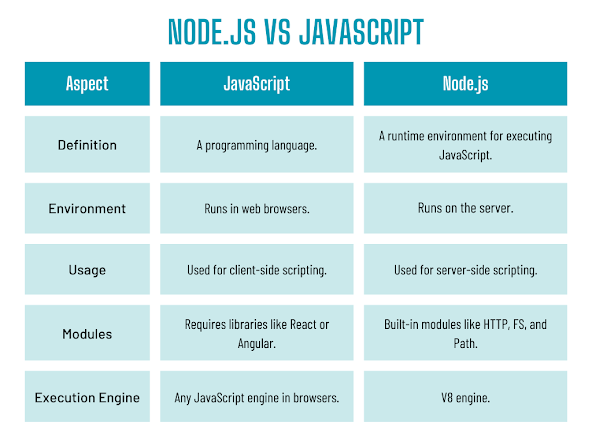
Here’s a detailed comparison highlighting the key differences between JavaScript, a programming language, and Node.js, a runtime environment for executing JavaScript.


Use Cases for JavaScript and Node.js

JavaScript Use Cases:

  1. Interactive Web Pages: Adding animations, form validation, and user interactions.
  2. Single-Page Applications (SPAs): Frameworks like Angular and Vue.js.
  3. Game Development: Browser-based games using libraries like Phaser.js.
  4. Progressive Web Apps (PWAs): Enabling offline capabilities and push notifications.

Node.js Use Cases:

  1. API Development: Building RESTful APIs for applications.
  2. Real-Time Applications: Chat applications, live notifications, and collaborative tools.
  3. Microservices Architecture: Lightweight and scalable solutions.
  4. Server-Side Rendering: Rendering React or Angular apps on the server for improved performance.

Advantages of Using JavaScript and Node.js Together

Combining JavaScript and Node.js unlocks the potential for full-stack development, allowing developers to use a single language across the stack. Here are some advantages:

  • Consistency: Use JavaScript for both front-end and back-end.
  • Faster Development: Shared libraries and reusable code.
  • Large Community Support: Access to extensive resources, frameworks, and tools.
  • Cost-Effective: Reduced learning curve and efficient resource management.

Trends and Industry Usage

Both JavaScript and Node.js remain at the forefront of modern software development:

  • JavaScript Frameworks: React and Angular continue to dominate front-end development.
  • Node.js in Enterprise: Companies like Netflix, LinkedIn, and PayPal leverage Node.js for scalable server-side applications.
  • Emerging Technologies: Node.js is increasingly used in IoT and serverless architecture.

Conclusion

JavaScript and Node.js are essential technologies that serve different but complementary roles in software development. While JavaScript is a programming language primarily used for client-side scripting, Node.js extends its capabilities to server-side applications. Together, they form the backbone of modern web development, enabling developers to build efficient, scalable, and robust applications.

Understanding their differences and strengths will help you make informed decisions, whether you are a developer choosing a tech stack or a business deciding on the right technology for your next project.


Frequently Asked Questions (FAQs)

1. Can JavaScript be used without Node.js?

Yes, JavaScript can be used independently in web browsers for client-side scripting without requiring Node.js. Node.js is needed only for executing JavaScript on the server side.

2. Is Node.js a programming language?

No, Node.js is not a programming language. It is a runtime environment that allows JavaScript to be executed outside of a browser.

3. What are the advantages of Node.js over traditional server-side languages?

Node.js offers a non-blocking I/O model, scalability, and the ability to use JavaScript for both front-end and back-end development, making it faster and more efficient for certain types of applications.

4. Can I build a full-stack application using only JavaScript and Node.js?

Yes, using JavaScript for the front-end and Node.js for the back-end, you can build a full-stack application. Popular frameworks like React (front-end) and Express.js (back-end) simplify this process.

5. Is Node.js suitable for large-scale applications?

Yes, Node.js is highly suitable for large-scale applications, especially those requiring real-time features like live chats, streaming, and collaborative tools.

6. What are some alternatives to Node.js?

Alternatives to Node.js include Python with Django or Flask, Ruby on Rails, PHP with Laravel, and Java with Spring Boot, depending on your project’s requirements.

App Cost Calculator: How to Get an Instant Price Estimate for Your Next Project

App Cost Calculator: How to Get an Instant Price Estimate for Your Next Project Introduction Planning to develop an app but unsure about t...